Not Dark Yet
Bob Dylan's second act

I.
They say it was bat shit that almost did him in, something he might have breathed in while riding his motorcycle on a gusty spring day, or maybe at a rest stop before a show in Memphis, or maybe while he was taking a walk in the woods. The fungus is called histoplasma capsulatum, and it grows on bird and bat droppings in the Mississippi and Ohio River Valley, when the air is thick with pollen and the rivers are stagnant with muck. If it gets into your lungs, it can swell the sac around your heart, make it hard to breathe, give you a stabbing pain in your chest, and eventually, if left untreated, stop your heart entirely. That’s what almost happened to Bob Dylan in May of 1997.
He had wandered in the wilderness since his temporary conversion to evangelical Christianity in 1978 and the trilogy of gospel albums that followed. Despite the musical strengths of those records, and the fiery live performances that accompanied them, the press, as well as many Dylan fans, didn’t take kindly to being proselytized to and looked upon his conversion as a betrayal. He abandoned the fire-and-brimstone tone after a few years, but the odd critically acclaimed album—Infidels in 1983, Oh Mercy in 1989—was always followed by a disappointing sequel, like 1985’s Empire Burlesque or 1990’s Under the Red Sky. On tour he was erratic, sometimes brilliant but often sloppy, maybe drunk. In 1991 he was given a Grammy Lifetime Achievement Award, performed a nearly-unrecognizable version of “Masters of War,” took the stage sweating and fidgeting next to a grinning Jack Nicholson, and gave a strange oration:
Well, my daddy he didn’t leave me too much, you know, he was a very simple man, and he didn’t leave me a lot, but what he did tell me was this—he said so many things, you know. He did say, “Son, you know it’s possible to become so defiled in this world that your own father and mother will abandon you. And if that happens, God will always believe in your ability to mend your own ways.” Thank you…
He had never been one for straightforward speeches, but it was a distressing sight. Around the same time, he was performing “Desolation Row” in Australia when his eyes flooded with tears, and he had to retreat to the back of the stage to compose himself. He had been attempting to sing the lines “You would not think to look at him / But he was famous long ago.”
The early nineties also brought two records of traditional folk and blues covers: Good as I Been to You and World Gone Wrong. Both were well-received, but to outside observers they seemed to signal a retreat to the source, a surrender, an exhaustion. The icon of the counterculture, the mercury kid whose songs spilled out of him faster than he could write them down, who burst out of the coffeehouse folk scene with protest anthems and love ballads of startling power and originality, who left all that behind for sunglasses and amphetamines and blaring electric guitar, who wrote and released Bringing it All Back Home, Highway 61 Revisited, and Blonde on Blonde in a matter of months, who made his own myths wherever he went: Newport, “Judas!,” the motorcycle crash, Woodstock, The Basement Tapes, Blood on the Tracks, the Rolling Thunder Revue…that guy… that guy was out of ideas. We would never see his like again.
So most people thought, anyway. In reality, he was on the road, purifying and refining himself, searching for new spaces in the old sound. His revitalization had begun in 1987, on tour with Tom Petty, out of inspiration and considering retirement. His last two albums had been critically savaged and he found he could hardly write anymore, relying on partners like Sam Shepard and the Grateful Dead’s Robert Hunter to whip his songs into shape. On stage, he often wore a hoodie and dark glasses, barely looking at the audience. He felt as if his own songs had become strangers to him, like (he wrote in his memoir Chronicles) “an old actor fumbling in garbage cans outside the theater of past triumphs.” One last tour and he would call it quits, retreat to his compound in Malibu or his farm in Minnesota, maybe spend the rest of his days playing the old spirituals and murder ballads he loved, maybe play nothing at all.
Something happened to him on stage in Locarno, Switzerland. In Chronicles, he is almost comically vague about the nature of this revelation, but a 1997 Newsweek interview offers slightly more clarity. He was standing on stage when everything seemed to suddenly drop out.
It’s almost like I heard it as a voice. It wasn’t like it was even me thinking it. “I’m determined to stand, whether God will deliver me or not.” And all of a sudden everything just exploded. It exploded every which way. [...] After that is when I sort of knew: I’ve got to go out and play these songs. That’s just what I must do.
There were two other revelations that same year: one came while watching a jazz singer in San Francisco, the other had to do with a kabbalistically complex new guitar technique based on the number three, both of which are discussed in Chronicles with the same sense of vague awe, rushes of feeling that can’t be explained. Whatever happened, he was off the next year on what fans took to calling the “Never-Ending Tour,” a grueling schedule of live performances, often over a hundred a year, which he has maintained ever since. (He played only 166 shows between 1980 and 1987, and around 250 in the miraculous 1961-66 period. Between 1988 and the present, he has played over 3,500.) Written off as a relic, away from the distractions of celebrity, he was able to find new ways to approach his music and his own legend, often performing similar setlists but with arrangements changing from show to show—one night a song might be a stately waltz, the next night a ferocious country blues. It wasn’t a straight line upward from there, there were plenty of flubs, bad shows, crises, and low moments. But slowly, surely, he was pulling himself out of the pit.
So when he got through that hospital stay (“I really thought I’d be seeing Elvis soon,” he cracked to the press), he might have grinned at the irony, that just as he was set to make his return to the popular consciousness, he was almost cut down by the same muddy river country that had birthed the whole tradition of American vernacular music in which he worked. He spent six weeks off his feet, and then got right back on tour, still weak and on medication, sleeping hours a day on the bus, saving all his energy for that night’s show. And in September 1997, he released Time Out of Mind, his most universally hailed album since 1975’s Blood on the Tracks and the beginning of the most startling second act in American popular music.
Time Out of Mind was humid and haunted, full of phenomenal fire and mystery. Oh Mercy producer Daniel Lanois swathed Dylan’s voice in reverb and murk, often filtering it through an old amplifier that made it sound like it was coming from a busted radio. Just like Highway 61 Revisited, Time Out of Mind began with the sound of an organ, but instead of the fierce, joyful lift of “Like a Rolling Stone,” with its gunshot snare and rumbling guitar and words tumbling out—onceuponatimeyoudressedsofine, etc—the organ on opening track “Love Sick” was the loneliest sound you could imagine, the lyrics spare and simple:
I’m walkin’
Through streets that are dead
Walkin’
With you in my head.
“I’m sick of love,” the chorus went “I wish I’d never met you.” Elsewhere, “You left me standing in the doorway crying / I’ve got nothing to go back to now.” Elsewhere, “Last night I danced with a stranger / but she just reminded me you were the one.” It’s always a dangerous game to read an artist’s personal life into their music, and Dylan has always maintained that the two are separate entities, famously claiming the stormy breakup songs on Blood on the Tracks, universally seen as springing from the end of his relationship with his then-wife Sara, were inspired by nothing more than reading Chekhov. But just as no one could write “Idiot Wind” just by reading Uncle Vanya, no one could write the blasted songs of hopelessness and despair on Time Out of Mind unless he was really, really going through it.
Dylan’s batshit-induced brush with mortality took place after Time Out of Mind was written and recorded; it’s an eerie coincidence, but not an inciting incident. That didn’t stop the press, perhaps high on Johnny Cash’s recent death-haunted comeback American Recordings, from characterizing Time Out of Mind as the 55-year-old Dylan’s one-foot-in-the-grave mortality record, particularly album highlight “Not Dark Yet,” ballad “Trying to Get to Heaven” and epic closer “Highlands,” in which Dylan fantasizes about a lost Eden while sitting in a Boston diner that might as well be purgatory. It’s admittedly hard to listen to his dirt-road voice growl “It’s not dark yet / But it’s gettin’ there” or “The party’s over and there’s less and less to say / I got new eyes, everything looks far away” and not think about death, but read the lyrics of Time Out of Mind closely and you’ll find they refer more to despair, depression, and heartbreak than to the Big Casino itself. (As late as 2011, Gilbert Cruz, then of Time, now head of the New York Times Book Review, was calling “Not Dark Yet” “a moving end-of-life song written and sung by an aging artist who has somehow managed to remain vital.”) Dylan, who had dealt with the projections and expectations of the press for nearly forty years now, laughed it off:
People say the record deals with mortality — my mortality for some reason! [Laughs] Well, it doesn’t deal with my mortality. It maybe just deals with mortality in general. It’s one thing that we all have in common, isn’t it? But I didn’t see any one critic say: “It deals with my mortality” — you know, his own. As if he’s immune in some kind of way — like whoever’s writing about the record has got eternal life and the singer doesn’t. I found this condescending attitude toward that record revealed in the press quite frequently, but, you know, nothing you can do about that.
But you can’t entirely blame them for thinking so. There’s a cosmic feeling in Time Out of Mind, a feeling older and deeper than anything that could be accessed by the buzzing stream-of-consciousness wild kid of the early years or the tormented wanderer of the middle ones. It’s partially due to Lanois’s production, which aims for what he calls “depth of field,” the recreation on a record of the washes of sound and blending of tones that occur in a three-dimensional environment. For him, this emerges not as a crisp, you-are-there quality, like the Blue Note jazz records from the 1950s and 1960s, but as something like the dream of a song, where instruments continually shift, emerge out of a haze of smoky echo for a few seconds, then disappear.
It’s also partially due to Dylan’s compositions. Time after time, the saddest lines in the world are augmented by music that wraps the listener up, murmurs assurances, shows us that life is full of hardship and trouble but we’ll get through it, really we will. Alex Ross, in a 1999 New Yorker essay on Dylan, writes about “Not Dark Yet”:
The song ends, “I don’t even hear a murmur of a prayer / It’s not dark yet, but it’s getting there.” This couldn’t be bleaker, could it? Bob Dylan stares into the face of death and decay. But as he sings “murmur of a prayer” he lifts the tune yet another step and does a graceful little turn at the top, creating an altogether new melody. And he slips in a triplet—a slight dancing rhythm that someone else picks up on guitar. As the song winds down, it’s not the darkness that lingers but the freshly swaying motion in the music, and that momentary possibility of a “murmur of a prayer.” The man who worships Hank Williams is looking back at “I Saw the Light”—a would-be uplifting gospel number that was really filled with terror. “I saw the light, I saw the light, / No more darkness, no more night,” Hank insisted, in a melody that fell, and you didn’t believe him. Bob declares, with a gallant upward turn, “I don’t even hear a murmur of a prayer.” You don’t believe him, either.
The same technique is used on “Trying to Get to Heaven,” where the music behind lines like “When you think that you’ve lost everything / you find out you can always lose a little more” sounds weary, but resolute, and where the ending harmonica solo is a defiant one-note chug, a pledge to keep going. And on “Standing in the Doorway,” where a desperate lovers’ plea is backed by simple, romantic arpeggios; a doo-wop 45 playing in an empty high school gymnasium. All of this combines to give the record oceanic sense of wisdom, of the whole journey from anger to despair to acceptance. It somehow seems to knows more about life than Dylan does, or than we do.
II.
After Time Out of Mind, something came loose and the floodgates opened. Dylan’s output from 2001-2006 encompasses two records of originals, “Love and Theft” (quotations intentional) and Modern Times, his fractured and fascinating memoir Chronicles, the film Masked and Anonymous, which he co-wrote and starred in, several great songs buried on film soundtracks, the first season of his radio show Theme Time Radio Hour, and hundreds upon hundreds of live performances, many of them, with their slick and revitalized countrypolitan sound, counted among the best of the Never-Ending Tour. There hadn’t been anything like it since the initial five year stretch in which he went from fresh-faced Woody Guthrie acolyte to shamanic spirit of the age.
Yet unlike that time, when the great spotlight of the world had swiveled and shone upon him strong enough to blind, and reporters and critics and barefoot young seekers had grabbed at the hem of his garment and begged him to lead them, the older Dylan, now comfortably categorized as an American Icon, was free to build up a private universe, a dangerous and alluring world of carnival barkers, street hustlers, jobbing comedians, busking musicians, con men, card sharps, and leering minstrels. His persona in these years was like Old Bull Lee, the William Burroughs stand-in in On the Road, who:
…had a sentimental streak about the old days in America, especially 1910 when you could get morphine in a drugstore without prescription and Chinamen smoked opium in their evening windows and the country was wild and brawling and free with abundance and any kind of freedom for everyone.
His interest went back a bit further than that; he landed on the Civil War and Reconstruction as the period from which everything that concerned him sprang. He wrote in Chronicles of how, when he first arrived in Greenwich Village, he would spend biting winter days in the New York Public Library, reading newspapers from that era on microfilm, how he found himself convinced that it marked a moment in which “the common destiny of the human being [was] thrown off course.” The South’s stubbornness on slavery damned us all, he determined, not only because of the frenzy of killing it provoked but because the war set the stage for the final consolidation of Northern industrial power, the replacement of the rhythms of the land with tightly-regulated clock time, and the imperial march of conquest and murder, first across the plains, then across the seas. But it was also a new beginning, and as former slaves were able to congregate freely for the first time, they created the music that, together with border ballads and nursery rhymes and hymns and all the other oral literature of America, would eventually evolve into the musical tradition in which Dylan worked. “Back there,” he wrote, “America was put on the cross, died and was resurrected.”
There was nothing synthetic about it. The godawful truth of that would be the all-encompassing template behind everything that I would write.
I crammed my head full of as much of this stuff as I could stand and locked it away in my mind out of sight, left it alone. Figured I could send a truck back for it later.”
Forty years later, the truck pulled up at his door. Both “Love and Theft” and Modern Times lift extensively from Walt Whitman, Mark Twain, and Henry Timrod, the all-but-forgotten poet laureate of the Confederacy, often pairing his florid Victorian lines with a gutbucket blues couplet (Well a childish dream is a deathless need / And a noble truth is a sacred creed / My pretty baby, she’s lookin’ around / She’s wearing a multi-thousand dollar gown.) “Nettie Moore,” a sparse, spiraling number on Modern Times, one of those songs that feels as if it has always been playing somewhere and was just waiting for someone to discover it, is based in part on a ghoulishly saccharine Confederate ballad called “Gentle Nettie Moore,” about a slave pining for his lover, who has been sold away. In Masked and Anonymous, an utterly bonkers and surreal film in which Dylan plays “Jack Fate,” a musician sprung from prison to play a shady benefit concert, the near-future America depicted is in a state of civil war itself, presided over by a gaudy dictator and marked by street violence and corruption. (Director and co-writer Larry Charles recalled that Dylan was “very, very obsessed with the Civil War” during filming.) In one scene, Dylan and his band sing “Dixie” to an enrapt and conspicuously racially mixed audience, which includes a man dressed as Abraham Lincoln. And on “‘Cross the Green Mountain,” a great song buried on the soundtrack to Ted Turner’s failed 2003 Civil War epic Gods and Generals, Dylan’s narrative seems to rise up from the scarred and smoking battlefields of the war, up from “the dim Atlantic line” where “the ravaged land lies for miles behind,” to encompass human conflict in all its eternal folly, ending on a redemptive rather than vindictive note:
They were calm, they were blunt, we knew ’em all too well
We loved each other more than we ever dared to tell
A view that the Civil War was a Greek tragedy and not the triumphant Second American Revolution, as it is more commonly characterized as in liberal circles today, shouldn’t be misread as some sort of Lost Cause nostalgia or apologia for the Confederacy, certainly not from the man who wrote “Only a Pawn in Their Game” and “The Lonesome Death of Hattie Carroll.” “This country is just too fucked up about color,” Dylan growled in a contentious 2012 Rolling Stone interview. “Blacks know that some whites didn’t want to give up slavery – that if they had their way, they would still be under the yoke, and they can’t pretend they don’t know that [...] It’s doubtful that America’s ever going to get rid of that stigmatization. It’s a country founded on the backs of slaves. [...] There’s nothing heroic about any lost cause.”
The title of “Love and Theft” seemed at first to be nothing more than a neat summation of the task of the artist, and a wink towards those who had taken Dylan to task for lifting lines and melodies from so many old songs. But Dylan fans, newly empowered by a nifty invention called the internet with the ability to track down every reference and allusion, quickly realized it also shared a name with an academic book by Eric Lott, the full title being Love and Theft: Blackface Minstrelsy and the American Working Class. The image of the minstrel had been a spectral presence in Dylan’s art for a while now. He had famously donned whiteface on the Rolling Thunder Revue tour, and before recording Oh Mercy in 1989, he had sent Daniel Lanois and his mixing engineers a tape of Al Jolson performances with the note: “Listen to this, you can learn a lot.” In Chronicles and in various interviews, he recalled seeing one of the last blackface minstrel shows at a traveling carnival in Duluth. And in Masked and Anonymous, Dylan’s character is visited by the ghost of an old showman played by Ed Harris, in the full white-gloved blackface getup.
It’s difficult to determine an easy moral or a didactic point in his use of this charged imagery, but Eric Lott, for his part, addressed Dylan in Black Mirror, his follow-up to Love and Theft, writing: “I would guess that Dylan regards minstrelsy, whatever its ugliness, as responsible for some of the United States’ best music as well as much of its worst.” Few would claim a love for minstrel music the way one might love the country blues or Appalachian folk ballads; it’s kept out of sight, spoken of in low tones, American music’s madwoman in the attic. (Dylan mentions that madwoman—Jane Eyre’s Bertha Mason—in “Love and Theft”’s “High Water,” slipping her name into a Charley Patton line.) But it was, as Nick Tosches wrote in Where Dead Voices Gather, “the first emanation of a pervasive and purely American mass culture,” and a major influence on all that followed it, a thick root of the tree of American music, even if it is a poisoned one. To work honestly in this tradition, to be a middle-aged white man from Minnesota convincingly able to sing “Had to go to Florida, dodgin’ them Georgia laws” or “I got a house on the hill, I got hogs out lyin’ in the mud,” without sounding like some leather-pants millionaire poking around in a tradition he had no business in, like the many other middle-aged rock musicians who have “gone back to their roots” and gotten really into the blues, Dylan had to drag this music’s history into the light, and transfigure it into something new.
Taken together, “Love and Theft,” Masked and Anonymous, and Modern Times feel like one of those great turn-of-the-millennium American novels, like Paradise, Mason and Dixon, or Underworld: deep and ambitious attempts to wrestle with national history, to determine whether all its war and racial strife and pain was inevitable or preventable. As in those novels, no easy answers to that question are forthcoming, but the world they create in their search is sinister, captivating, beautiful, and true. They’re the art of a man with nothing left to prove to anyone, able to collapse time and speak through many voices, free to be as strange as he wants.
Not that his work was all church bells and horse-drawn carriages; on those records the nineteenth century sat alongside the mid-twentieth, the world of possibility and speed and teenage freedom opened up by the 45 single and the radio and the automobile, with some winks to the present day thrown in as well. (A reference to Alicia Keys on Modern Times jolts the listener upright, it’s like seeing a television in a Jane Austen adaptation.) The same year he released Modern Times, Dylan began presenting his satellite radio show Theme Time Radio Hour, in which he not only played an hour of songs centered around a loose theme—“Mother,” “Baseball,” “Days of the Week,” and so on—he also stepped into the role of smooth-talking DJ, giving offbeat biographies of each musician, answering listener emails, cracking jokes, reading beat poetry, and sharing cocktail recipes, in a voice that sounds like Bob Dylan’s idea of someone doing a Bob Dylan impression. (It’s a delight to hear him bite into words you’d never thought you’d hear him say, like “SpongeBob,” “Attention Deficit Hyperactivity Disorder,” and “Wikipedia.”) Theme Time left behind the 19th-century carnival atmosphere of his earlier work and skipped forward to a noirish Edward Hopper landscape of lonely men in diners and sad women in jazz clubs. Each episode begins with a sort of urban haiku from actress Ellen Barkin. “It’s night time in the big city,” she says “There’s a strange car parked outside.” Or “Fog rolls in from the waterfront.” Or “A man gets drunk and shaves off his mustache.” The music ranged all over, but mostly stuck to the 1940s, 50s, and early 60s, the music that inspired him as a young boy. In one episode, a listener writes: “Dear Theme Time Radio Hour, I notice you play a lot of old songs. What do you have against new songs?” “Well,” he rasps, and one can hear the wry smile, “truth is, there’s a lot more old songs than there are new songs.”
Every episode was quickly catalogued and archived by online fans, but mysteries remained. Were the emails he answered genuine or was the entire show scripted? Where was “Studio B, the historic Abernathy building,” where the show was purportedly recorded? (It didn’t exist.) Was it a coincidence that the names of associate producers “Sonny Webster,” “Ben Rollins,” and “Nina Fitzgerald-Washington” were all taken from famous jazz musicians? (Almost definitely not.) What about studio engineer “Tex Carbone,” was he real? (Unknown.) And who was the announcer, “Pierre Mancini,” who rattled off these names at the end of each episode? (He was suspected to be the voice of Eddy Gorodetsky, screenwriter and producer of various 1990s sitcoms, obsessive music collector, and friend of Dylan’s who was behind both Theme Time Radio Hour and Dylan’s cameo appearance on Dharma and Greg.) In one sense, these little pranks and in-jokes didn’t really matter. In another sense, they were a key into the whole project: helping to restore a lost sense of romance to American music, showing people what it was like on clear nights when the young Dylan, the solitary and dreamy kid in Hibbing, Minnesota, could hear the Grand Ole Opry and the National Barn Dance and the R&B and blues stations from Shreveport and Jackson and New Orleans, blasting up from the southern states all the way up into the Iron Range on their 50,000 watt AM transmitters, all those unknown and enticing worlds singing in the wires.
2009’s Together Through Life was co-written with the Grateful Dead’s lyricist Robert Hunter, and the accordion featured on every track brought Dylan’s sound into the Texas-Mexico borderlands, the landscapes of Lonesome Dove and Giant with their wild horses and rolling clouds. One would think a collaboration between two of the great American lyricists would be a monumental event, but Together Through Life is more of a laid-back, likable affair, a lighthearted record for summer drives and young romances, if you don’t mind your romance being soundtracked by Dylan’s croaky voice. 2012’s Tempest brought the sturm und drang back, with rough, sinister tracks like “Pay in Blood,” “Scarlet Town,” and the fourteen-minute title track about the Titanic. It’s as reliably good as anything post-Time Out of Mind, but one knows the formula by now: a few straightforward blues tracks, a 1940s-style moon-June love song or two, an epic closer, the continued evocation of the world of (as he put it in Chronicles) “outlaw women, super thugs, demon lovers, and gospel truths [...] Stagger Lees, Pretty Pollys, and John Henrys,” and no mention of any technological innovation more recent than the jukebox. No one, of course, would have begrudged him for releasing records of this quality until the day he died; he had already proved that he could reinvent himself many times over. But he was as restless as ever, and beginning in 2015, he reinvented himself once again, this time as a singer of other people’s songs.
III.
“If you have the time, can I tell you how I grew up?,” Bob Dylan asked Daniel Lanois, the afternoon light streaming into Lanois’s kitchen. He had just finished recording twenty-one Great American Songbook standards at Capitol Records Studio B, Sinatra’s old haunt. Recalled Lanois:
He spoke for an hour and a half on how, as a kid, you couldn’t even get pictures of anybody. You might get a record but you didn’t know what they looked like. So there was a lot of mystery associated with the work at the time. As far as hearing live music, he only heard a couple of shows a year, like the Tommy Dorsey Orchestra might come through.
But the music he did hear really touched him and he felt that a lot of that music was written not only by great professional songwriters at the time, but a lot of it was written from the heart, from the wartime, and people just pining for a lover. He felt there was a lot of spirit in that music. He felt there was a kind of beauty, a sacred ground for him.
After having said all that, we then listened to the music and I felt everything that he talked about. For one of America’s great writers to say, ‘I’m not gonna write a song. I’m gonna pay homage to what shook me as a young boy,’ I thought was very graceful and dignified.
Several times in his career, Dylan has retreated to the canon of popular song to revitalize himself, and each time the critical establishment has reacted like a spurned lover. Self-Portrait, a rambling double album of traditional ballads, contemporary covers, and studio outtakes released in 1970, was widely seen as a mark of artistic exhaustion (“What is this shit?,” began Greil Marcus’s 7,000 word review/breakup letter in Rolling Stone), as were Good as I Been to You and World Gone Wrong. When Dylan released Shadows in the Night, the first of his three albums covering the pop standards of the 1930s and 40s, the response was warily respectful. Dylan’s affection for this music was evident to anyone who listened closely to his late period. “Bye and Bye” and “Moonlight” on “Love and Theft” and “Spirit on the Water” and “Beyond the Horizon” on Modern Times were near-straightforward attempts to write in this style, albeit with lyrics more ambiguous and unsettling than their inspirations.
But when Shadows in the Night was followed by Fallen Angels a year later and the 30-song Triplicate a year after that, people began to get antsy. Was this some sort of a joke? Was Dylan’s last act really going to be covering these well-worn songs in (what biographer Ian Bell called) his “magnificent ruin” of a voice, putting his cracked and guttural instrument up against Sinatra and Billie Holiday and all the great jazz and pop vocalists of the century? Ten well-chosen songs were one thing, but fifty? And anyway, didn’t the embrace of the Great American Songbook usually signify the bland winding-down of a career, as it did for Rod Stewart and Paul McCartney, or a desperate attempt to look mature, as it did for many an American Idol contestant?
In retrospect, one can enjoy Dylan’s ventures into interpreting the songs of others armed with the knowledge that more was yet to come, that Self-Portrait was a part of the process that would eventually birth Blood on the Tracks, that Good as I Been to You and World Gone Wrong laid the foundation for Time Out of Mind, and that the standards albums were followed by the magnificent Rough and Rowdy Ways. But the three standards albums are more than a technical exercise or a creative sidequest, there are deep truths and mysteries in them just as there are in the albums of originals. In The Old, Weird America, his book on the origins of Dylan’s Basement Tapes, Greil Marcus wrote of an answer Dylan gave to a critic who asked him about Bruce Springsteen.
People like Springsteen had missed something, Dylan said, with Springsteen only eight years younger and still born too late: “They weren’t there to see the end of the traditional people. But I was.” What was he saying? He might have been saying that as in 1963 he watched Boggs, Mississippi John Hurt, Skip James, Clarence Ashley, Buell Kazee, Sara and Maybelle Carter— “the traditional people,” standing on the Newport stage, for Dylan’s cryptically perfect phrase, both as themselves and as a particularly American strain of fairy folk—he had learned something about persistence and renewal. Or he might have been saying something simpler, and harder: I saw a vanishing. He was present to witness an extinction, to see the last members of a species disappear. Thus it was left to him to say what went out of the world when the traditional people left the stage.
He would thread the work of the “traditional people” throughout the songs of his late career; in nearly every composition of his from 1997 onward there is a borrowed line or melody from an obscure country, R&B, or blues song. Writers like Marcus venerate Dylan because he carries the torch for this lost America, which has been systematically commercialized, paved over, and forgotten; the general stores turned into Wal-Marts, the juke joints and roadhouses replaced with their ersatz equivalents.
Yet there was a commercial culture in that period, too. The flipside of the Old, Weird America, of the bluesmen and the jug bands and the Sacred Harp singers, was the melodic and sophisticated world of Irving Berlin, George Gershwin, Richard Rodgers and Lorenz Hart, songs that, from the First World War to the end of the Baby Boom, formed the raw material for a million dreams, narrated a million triumphs and heartbreaks, soundtracked the everyday troubles of everyday people. Were the men and women who wrote these songs, many of them, like Dylan, the descendants of European Jewish immigrants, any less deserving of the title “traditional people,” just because they grew up on the Lower East Side instead of in a Mississippi shack or a Kentucky holler? And just as he put an end to the Greenwich Village folk scene, as the old coffee houses filled with archivists and lefty intellectuals were flooded with a thousand wannabe Dylans, didn’t he also, by creating the figure of modern singer-songwriter as individual poet-genius, definitively slam the Great American Songbook shut? Might it be understandable, that he might want to help maintain the memory of what he inadvertently helped destroy?
“I don’t see myself as covering these songs in any way,” he wrote in the press release for Shadows in the Night. “They’ve been covered enough. Buried, as a matter of fact. What me and my band are doing is uncovering them. Lifting them out of the grave and bringing them into the light of day.” To do this, instead of attempting to replicate the lush orchestration of the 1950s, as most standards revival records had done, he stripped them down to their essence, just his voice accompanied by upright bass, pedal steel, and occasional flourishes of guitar, horns, and percussion, halfway between a sophisticated jazz trio and a particularly melancholy honky-tonk country outfit. He gave his beautiful arrangements their due space, often letting the introduction ride for a long while before he started to sing. He found that, just as old age gave a gravitas and meaning to the “traditional people” he watched in New York and at the Newport Folk Festival, it gave a sense of deep weight to these seemingly-ephemeral songs. Initially, there is something comical in listening to his gnarled voice perform these songs; play his version of “Some Enchanted Evening” to an unsuspecting listener and you’re sure to get a burst of surprised laughter when his vocal comes in. Yet sit with them and you begin to realize that there is a pathos that could only come from someone whose voice is so weathered, who has experienced so much of life, when he sings:
Love is funny or it’s sad
Or it’s quiet or it’s mad
It’s a good thing or it’s bad
But beautiful.
Or, in “Why Try to Change Me Now?,” a composition from 1952 that seems to have been written especially for an aged and reflective Dylan:
Why can’t I be more conventional?
People talk, people stare, so I try
But that’s not for me, cause I can’t see
My kind of crazy world go passing me by.
He used the contours of the standards, the education they offered in melody, phrasing, and timing, to retrain his voice, which years of touring had degenerated into a rough bark. Non-fans may laugh at the idea that Dylan’s late-career singing, an acquired taste if ever there was one, went through better and worse periods, but compare his voice now to that of live recordings from the early 2010s (when I first saw him in concert and dismissed him as well and truly over the hill) and you’ll find that he no longer sounds as if he has a Texas-sized frog in his throat. He is, post-standards albums, capable of a much greater delicacy, a strange kind of ragged beauty.
So we would all discover in late March of 2020, when the world seemed to rapidly be falling apart. “Greetings to my fans and followers with gratitude for all your support and loyalty across the years. This is an unreleased song we recorded a while back that you might find interesting. Stay safe, stay observant and may God be with you.” The message was attached to “Murder Most Foul,” the first single from Rough and Rowdy Ways, his first album of original songs in eight years. The seventeen-minute song begins as a ballad about the JFK assassination and then expands outward, as the dying president hallucinates a series of twentieth-century tableaus and moments in musical history, ending in a long series of requests to the midcentury radio DJ Wolfman Jack, of which only a small part is excerpted below:
Play, “Lonely At the Top” and, “Lonely Are the Brave”
Play it for Houdini spinning around his grave
Play Jelly Roll Morton, play, “Lucille”
Play, “Deep In a Dream” and play “Driving Wheel”
Play, “Moonlight Sonata” in F-sharp
And, “A Key To The Highway” for the king of the harp
Play, “Marching Through Georgia” and, “Dumbarton’s Drums”
Play, “Darkness” and death will come when it comes
Play, “Love Me Or Leave Me” by the great Bud Powell
Play, “The Blood-stained Banner”
Play, “Murder Most Foul”
Dylan is always discussed as a lyricist first and foremost, and many fans are first drawn in by the wild poetic force of the lyrics on the early records, which books like Christopher Ricks’s Dylan’s Visions of Sin analyze the same way one might analyze Keats or Milton. But “Murder Most Foul” isn’t self-consciously baroque, like “Desolation Row” or “Sad-eyed Lady of the Lowlands,” or magnificently stark and elemental, like “Simple Twist of Fate,” or “I Threw It All Away.” It’s a little obvious, goofy even. (‘“Twas a dark day in Dallas, November ‘63 / A day that will live on in infamy.”) Its rhyming couplets are like something you might make up in the shower. Your first reaction, upon hearing it, might be to roll your eyes at this hackneyed piece of boomer self-mythologizing. Oh, the JFK assassination was the day our national innocence died? Tell me all about it, Don McLean.
Yet all the elements of “Murder Most Foul” combine to make it one of his great late achievements. How utterly right and strangely comforting it felt, in those surreal and terrifying early pandemic days, to hear his voice over those hushed pianos and violins. You want to resist the song at first, scoff at how straight-faced and simple it is, but it beckons you in and, hypnotized, you follow. “The soul of a nation has been torn away / And it’s beginning to go into a slow decay,” he sang, and here was that decay finally making itself known, in mass death, in burning cities, in unemployment and unrest, and in the realization that no one, anywhere, knew what to do, that there were no experts in the room, that no one was coming to save us. And here was Dylan at 79, narrating one moment where, perhaps, the course of the country became inevitably set, but also narrating all that we have to celebrate, all the human vitality and intensity and love that found expression in the music of the twentieth century, which no corrupt politician or shadowy assassin could destroy.
As any great artist ages, their work becomes more imbued with leaden significance, treated as if it could be their deathbed statement to the world. Time Out of Mind had been received that way, but the records after had mostly avoided it—they were too playful and vaudevillian to carry such metaphysical weight. Rough and Rowdy Ways was different. When Dylan and Larry Charles were writing Masked and Anonymous, Charles recalls, they built the story and characters using a box of hotel stationery Dylan had filled with disconnected names and poetic phrases. One gets the sense that that’s how Dylan’s post-Time Out of Mind records were mostly written, as collages from many different half-remembered sources, more focused on creating an atmosphere than making literal sense. You could swap many of the lines lifted from old bluesmen and poets around and it wouldn’t make much of a difference.
Rough and Rowdy Ways was different, it spoke more directly to us. He sang of his own creative process on “I Contain Multitudes,” “My Own Version of You,” and “Mother of Muses,” of love on the tender “I’ve Made Up My Mind to Give Myself to You,” and of age and death on “Black Rider,” “Crossing the Rubicon,” and “Key West.” The backing band was delicate and nocturnal, just as it had been on the standards records. The lyrics were full of earthy humor and wisdom; it was like listening to Prospero, or late Yeats. And the record ended (by some accounts—“Murder Most Foul” is the last track on streaming services, but the CD version puts it on a separate disc) with “Key West,” a song somewhere between a brochure for the Florida tourist board and a Blakean vision of heaven, where the southernmost point of the nation is made into a gateway between this world and the next. It’s certainly possible that he’ll release more music, and the Never-Ending Tour certainly shows no signs of slowing down. But if the lulling accordion vamp that slowly fades and falls away at the end of “Key West” end up being the last notes he ever gives us on a record, it’ll be a ride off into the sunset as perfectly bittersweet and satisfying as you could imagine.
IV.
When he came to New York he famously sang to a dying Woody Guthrie in the hospital, which was both a sincere act of devotion from one artist to another and a canny PR move that helped position him as Guthrie’s heir. If there’s an heir to Dylan, I don’t see who it is. Great music and great art are still being made and will always be made, and one day someone of his stature will emerge. But this particular age of heroes is over. The world is too fractured for one person to change things the way he did, and there’s too much information out there to come from nowhere and create your own self. “To live outside the law, you must be honest,” he once sang, and it worked for him. Now we’re all bound by the law, constantly scrutinized and under surveillance, overly suspicious of anything that seems pure or true. Read the sections in Chronicles in which a fresh-faced Dylan arrives in New York with only a suitcase and a guitar, sleeping on couches and playing for spare change, spinning tall tales about his past to flannel-suited Columbia Records executives, and it feels unreal that all of this could have happened so recently, within living memory. It feels like reading about Johnny Appleseed, or Billy the Kid, or Luke Skywalker.
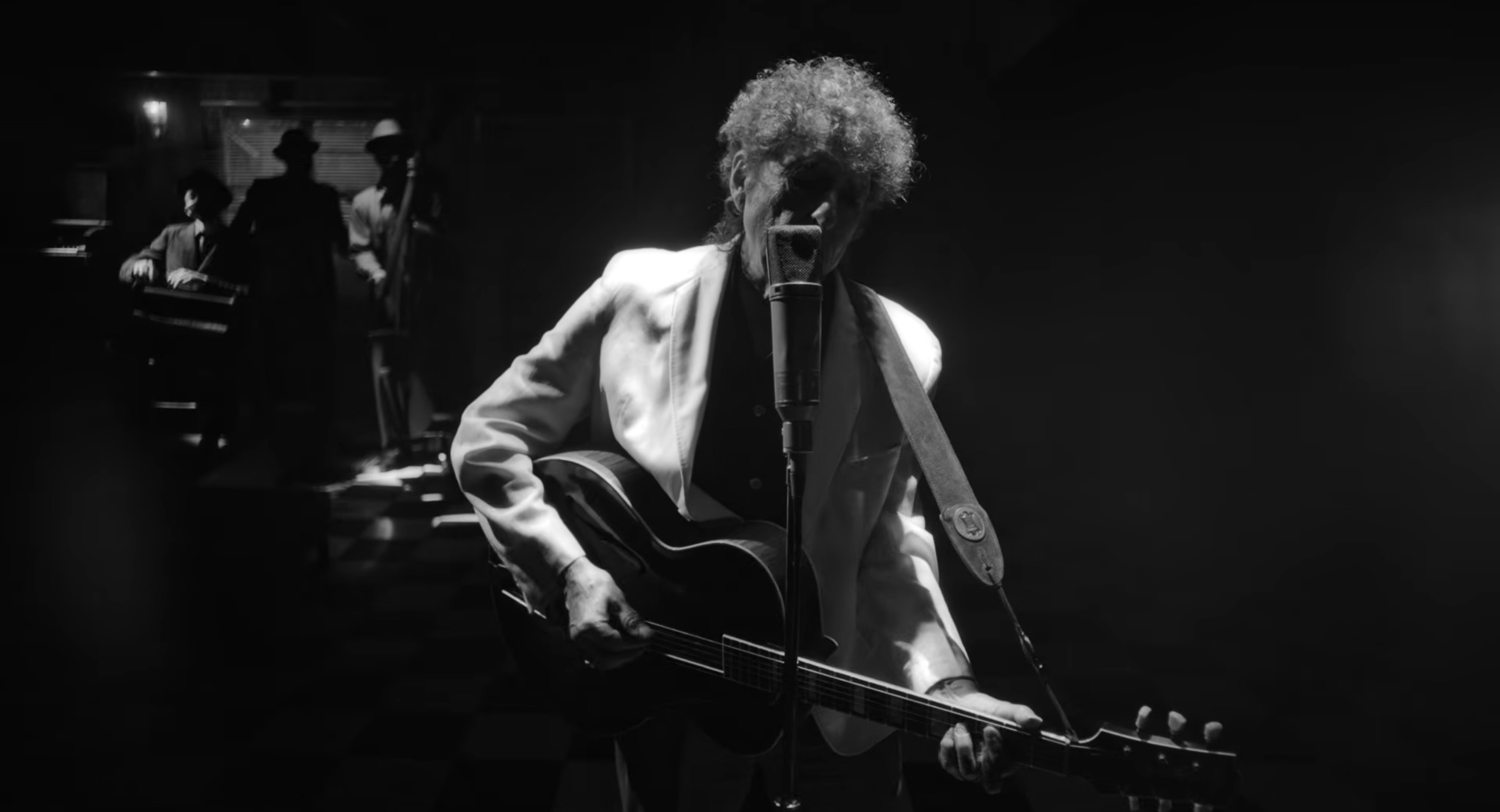
But beyond the cloud of rumors and ghosts and tall tales there is a corporeal man, a man I saw just a few weeks ago at an anonymous minor-league hockey rink and event venue in Palm Springs, where he and his band played languid, liquid roadhouse jazz versions of his songs—mostly from Rough and Rowdy Ways and Tempest with a few greatest hits and obscure covers thrown in. It was a greying crowd, as you might expect, and as has been the case with every Dylan show I’ve seen, some were rapturous and some hostile, wondering why he didn’t play recognizable versions of his hits, why he never took his hood off or addressed the audience, why he was so seemingly uninterested in giving us what we paid to see. But that has never been his game. Though he loves the gone world, the Old, Weird America, he has no affection for his own past and never bought into the founding myths of the generation he was made to speak for, the false promises of boomer counterculture, all of which fizzled out into the proverbial Deadhead sticker on a Cadillac. He only goes forward, trying his best to exhaust the possibilities of his songs and finding many of them to be inexhaustible. A few days before I saw him, in a brief interview in the New York Times, he had described himself as “an old king from some vanished country.” While I was watching him I thought of that old king, of Tennyson’s Ulysses, readying the ship for his final voyage, “Made weak by time and fate, but strong in will / To strive, to seek, to find, and not to yield.” I know he will die on the road.
I don’t want to think about that day, the day we’ll have to start considering what the world of American music looks like without him. But—God!—sometimes I just want to go up to people, random people on the street, and make them understand how lucky we are to have overlapped with him, to have lived at the same time as someone who, I have no doubt, will be as beloved in 200 years as Whitman and Blake are today. People wonder where all the titanic figures are, why everything seems so small these days, and all the while a giant strides in their midst. He saw the last of the traditional people. We saw the man who gathered up everything the traditional people ever did and turned it into something singular and beautiful. How lucky we are that he had this second act, that he learned to work side-by-side with the muse who had possessed him in his early years. How lucky that we learned from him what it looks like to keep your art vigorous and alive and never complacent, even after the fire of youth has gone. How lucky we all are, in these dark and desperate times, to have seen the last of his kind, the last emissary from the old world, to have seen Bob Dylan, the last great American myth.
That was wonderful, and so affirming that my lonely obsession is not so very lonely after all. I remember seeing him in 2001 or 2, growling through an opener of "I am the Man, Thomas" and thinking "no metal singer is this terrifying." And the first time post-Sinatra that I heard Love Sick, and understood how he had strengthened his voice, his phrasing, and his ironic wit on those songs, and how Love Sick, always a favorite, now slayed me on the spot. Inexhaustible and unimitable. I often have the wish to MAKE people understand and the realization that no one will.
Great shit here man. I knew your ending line was coming before I got there because Dylan made me an artist at 16. I heard him and that was it, I knew I wanted to write.
I only hope that when American myth dies with Dylan, it is reborn. It will have to be or we won't make it as a nation.