Midwestern Mindtrips
Meaghan Garvey's "Midwestern Death Trip"

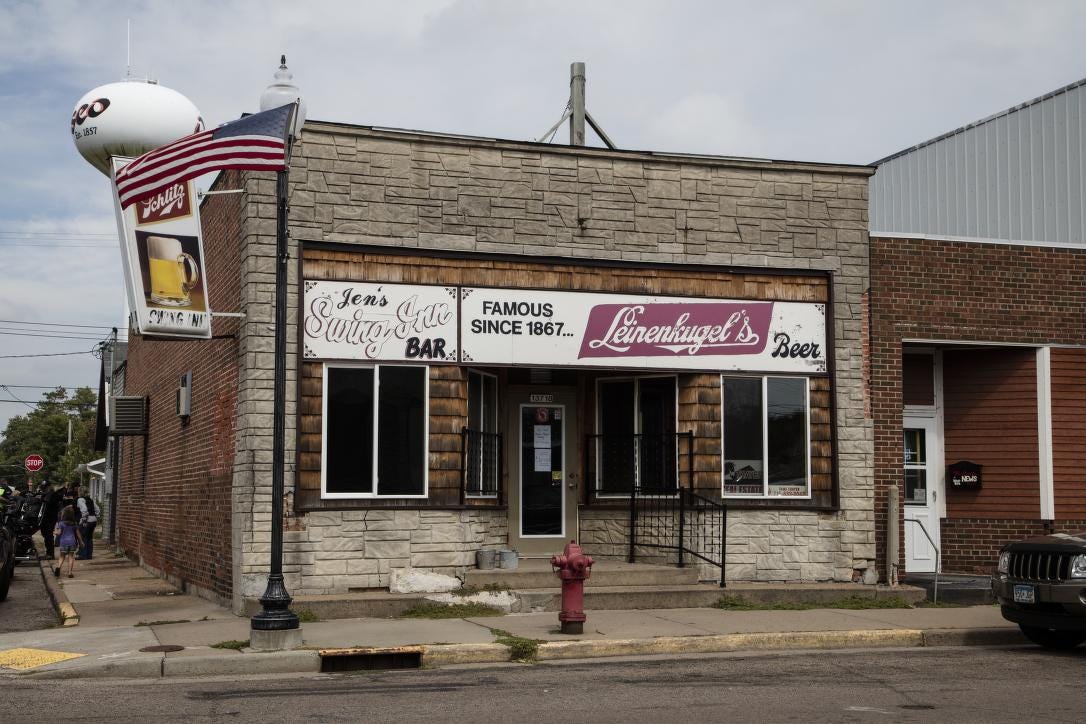
“His stuff is pure Proustian existentialism. Midwestern mindtrips to the nth degree…”
— Bob Dylan on John Prine
The highway is a good place to take stock of things. Drive the open road on your own with no destination in mind and before too long you’ll find yourself drifting through your memory palace, cataloguing regrets, lost loves, departed friends, and missed opportunities. Most people, long-haul truckers and wandering troubadours aside, don’t get the chance to reflect like that too often, given the petty distractions and responsibilities that fill up the working week. But writer Meaghan Garvey, poet laureate of this phenomenon, has distilled and bottled the experience for the rest of us in her looping, nonlinear, sort-of-travelogue sort-of-memoir debut, Midwestern Death Trip.
Back in October, I wrote a short profile of Garvey and her “vibes-based newsletter” SCARY COOL SAD GOODBYE for the Substack Post. I won’t repeat myself too much when discussing her work, but for newcomers, here’s the gist. Garvey’s work is a series of dispatches and trip reports, mostly from her native Midwest but occasionally from other environs. She travels to various dive bars, supper clubs, honky-tonks, roadside attractions, and other strange slices of America, meeting people, listening to their stories, and, one gets the sense, following some unnameable impulse within herself. She does all this in a fantastically evocative and singular voice, wry and understated, self-deprecating and charming.
Now, she’s back with a full-fledged book on County Highway’s Panamerica imprint. Most of the material in Midwestern Death Trip has its origins in SCARY COOL SAD GOODBYE, but all of it has been expanded upon, remixed, reworked, and contextualized—I never miss an issue of the newsletter and I still feel as if I got my money’s worth, though I did regret the absence of Garvey’s accompanying photographs of carpeted bars, neon signs, and lonesome backwoods. The book is made up of a series of separate essays, but has a satisfying narrative arc, with themes and characters and motifs dancing in and out of its 237 pages. Garvey attends the Lumberjack World Championships in Hayward, Wisconsin, searches for the ghost of a drowned pilot in Lake Michigan, and meets Lynchian eccentrics in Michigan’s Upper Peninsula. She considers the region’s long tradition of cult leaders, torch singers, and outsider artists. And she considers her own life: the early death of her mother, whose own writing dreams were frustrated, her penchant for self-destructive romances, and her choice to live a peripatetic life on the road.
Not that the new material is all boring auto-therapeutic memoir or anything; the stories of her most debauched days, when they’re not harrowing, are generally extremely funny. (I laughed out loud at the YouTube search history of a hippie roommate: “‘niel young live rare,’ ‘morel hunting in illinois,’ ‘amazing skills,’ ‘grateful dead live rare,’ ‘bikini fashion show 2020.’” Shortly after, he asks Garvey: “Hey, you wanna rip some lines and visit my friend’s grave?”) But compared to the stories in her newsletter, the book feels a bit more honest, a bit more circumspect. Garvey seems newly willing to let a darkness into her work that was always around the edges, but sometimes obfuscated in her newsletter was by her insouciant persona. The section on searching for “Seaweed Charlie,” the aforementioned pilot ghost, takes on a jittery, paranoid edge when you learn that she was cracked out on “Malaysian fighter-pilot speed,” the whole time; the celebrations of roadside America don’t ignore the palpable sense of decay and despair that suffuses much of the heartland.
The road trips around which Midwestern Death Trip is structured take place roughly between 2020 and 2025, and disquieting and hyperreal events—the trippy early pandemic days, the failed Trump assassination, the successful Charlie Kirk one—hover in the background of the book, occasionally forcing their way into the foreground in the form of a Wisconsin barfly mumbling conspiracy theories or in a supper club slickster who claims to have been Jeffrey Epstein’s personal exterminator. You should have to put five dollars in the cliché jar when you compare a female journalist to Joan Didion, so forgive me, but the way Midwestern Death Trip documents of the early 2020s reminds me of nothing so much as The White Album and its chronicle of the wave of bad vibes that slowly crept across America between the Summer of Love and Watergate. The pitched, eerie, detached tone here is pure JD.
Something in the atmosphere had shifted earlier that summer, and suddenly it felt as if reality were melting. The qualities that once distinguished real life from a simulation now seemed vague and muddled and worse, irrelevant. Mundane daily tasks required the utmost vigilance. [...] Information floated on intense waves of feeling that were always at the mercy of the changing winds of fate, otherwise known as “vibe shifts.” Each day, my texts were inundated by odd, flirtatious robots wondering whether I would like to have a picnic on Saturday or whether I was free to come over for beef stew.
But unlike Didion’s clipped WASPisms, there is within Garvey a great and friendly Midwestern sensibility, a fundamental decency and love of life, in both its big wins and its bad beats. Not everything is going great in Garvey’s America, in fact things are mostly going very badly, but that doesn’t mean that adventure isn’t worth seeking out and—crucially—that people aren’t worth talking to. There’s very little cynicism in Midwestern Death Trip about the human race, no big-city disdain for the weirdos she talks to, no political rancor, even as she makes her own views clear. It’s really refreshing to read something that has so much faith in people, and that makes such an effort to pay attention to their stories.
This act of generosity is all the more affecting because, even though it’s glamorous and romantic and fun to read about in all sorts of ways, the life she has chosen is not an easy one. She has made a decision to embrace the moment, without much of an eye on the future, and trust in the universe to provide, to forge ahead like Wile E. Coyote building the bridge in front of him as he goes, aware at any time he might find himself falling into the abyss. “I choose to be a stranger,” she writes in Midwestern Death Trip:
It is a role I play well. My friends with whom I used to drink have gotten married and started families. My father has remarried into a new family of his own. And me, I go from bar to bar, trading stories with people I’ll never see again. And I’d be lying if I said I didn’t plan for it to go this way.
She’s honest about the costs of that role, about her fraught relationship with her own barflydom, and about the possible futures she might be foreclosing on. So I feel profoundly grateful to her for playing it. Look around you and everything feels hyper-optimized, deeply anti-romantic. You find love via algorithm, you take pills to suppress your passions and appetites, you wake up every day to find new assurances that the unseemly business of self-expression will soon be entirely outsourced by machines. Sometimes it feels as if the world is in the hands of people who hate all the most ineffably human things: the second beer at the bar, the shared glance across the room, the act of artistic creation itself. So if an American literary tradition is going to flourish, we need writers like Garvey, who show through their example that you can still choose to dismiss all this and live a different way, even if that way comes with undeniable costs. Or, as she puts it, “Never take life advice from people who hate life.”
Let me end on a synchronicity that feels significant, even if it may be of interest only to myself. As I was reading Midwestern Death Trip, I was also in the preparation stages for an essay on Bob Dylan’s late career, the spectral, gothic vision of America he’s been conjuring up ever since 1997’s Time Out of Mind. Midwestern Death Trip and latter-period Dylan felt like ideal companions, both of them portraits of the country’s backroads and folk traditions that mixed strangeness and darkness with a certain resilient humor and curiosity. I wrote down as much in my notes, but figured I just thought as much because I’m always thinking about Dylan in some sense or another. But no! In the final essay, ten or so pages from the end, THERE HE WAS! Garvey travels up to his hometown of Hibbing, Minnesota and writes evocatively on not just Dylan but Late Dylan, claiming a preference, which I largely share, for his recent work over the classic 60s material, for the grizzled storyteller at the end of the bar over the young troubadour. On seeing him in Milwaukee with an ex-husband, she recounts:
Dressed in sequined black and hovering over the baby grand, an 82-year-old Dylan spent the next two hours obfuscating his own myth, reworking his most beloved songs to be unrecognizable or ignoring them entirely to play long, rambling new ones that shouted-out the Bible, Buddy Holly, Jimmy Reed, Allen Ginsberg, Elvis Presley, and Martin Luther King Jr. [...] He melted time into a roiling living history with no beginning or end, in which the forces of the sublime and the reckless perpetually clashed against death and decay. “I’m the enemy of the unlived meaningless life,” he yowled to the crowd of wine-drunk boomers. “Can’t remember when I was born and I forgot when I died.”
Afterwards, she describes a coffee-cup-flinging screaming match with said ex-husband in a very “Tangled Up in Blue” way, and writes of the lonely, desolate landscapes of Minnesota’s Iron Range, the wind-blasted steel towns Dylan was raised among. Somehow, the juxtaposition of the cultural and personal in this chapter captures a feeling—of how art fits into life, how it decorates it, raises the petty and mundane up into the spheres—that dozens of books by scrupulous and neurotic boomer Dylanologists miss.
Should I have expected that a chronicler of the Midwest would write about the greatest musician to emerge from the region? Probably. Did I nevertheless feel an electric shock when I came across the Dylan section, like it was a sign from the universe that I was on the right track, a sign that Garvey, Dylan, and myself, relative disparities in talent aside, shared an essential outlook: a set of beliefs, a sensibility, a yearning? Yeah, honestly, I did. So it feels right to say that this particular synchronicity cemented my belief that Midwestern Death Trip is a special book, that it earns a place near On the Road and Slow Days, Fast Company, near Two-Lane Blacktop and Paris, Texas, near Diamond Jubilee and Rough and Rowdy Ways. It’s one of those works of art that captures a certain spirit, one that can be found in the ruins and the decay, in the weed-choked neighborhoods, in the old bars, in the forgotten corners, in the freezing Minnesota winters, in the kindhearted strangers, and in the sparks of personality and strangeness and adventure that still remain, here in our crumbling republic.
ahhhh man gonna cry... I owe you like 10 beers next time I'm in LA <3
There are people out there who prefer late Dylan, and I feel SO FUCKING SEEN RIGHT NOW.